3D Scanning for Replacement Parts and Keepsake Replicas
- tonyperegrindesign
- 4 hours ago
- 9 min read
A small plastic latch cracks on an appliance. A tractor knob wears smooth. A classic car trim clip snaps after decades of service. The original part is no longer made, and the replacement stock has disappeared.
This is where 3D scanning becomes more than a clever piece of technology. It turns real objects into accurate digital models, creating a practical path from “we cannot find one” to “we can make one”.
The same process can also capture objects with personal value, not just mechanical parts. A child’s hand, a pet’s paw, a family heirloom, a hand-carved object, or a sculpted form can be scanned and reproduced as a solid keepsake in different colours, sizes, and materials.
3D scanning works because it bridges the physical and digital worlds. It captures shape, scale, texture, and detail quickly, then gives makers, designers, repairers, and families a file they can edit, store, and reproduce.
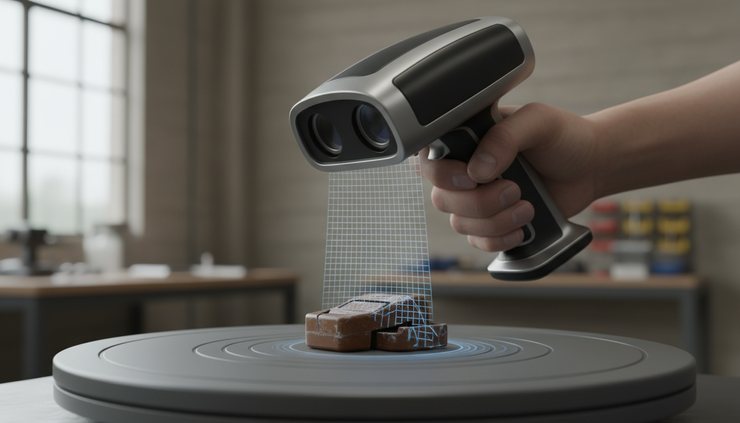
3D scanning gives old parts a second life
When manufacturers stop producing a part, the object itself can become the best source of information. If the broken part still has enough shape to measure, or if another intact part exists, a scan can capture the geometry needed to rebuild it.
This is useful for many everyday and specialist items, including:
Clips, brackets, handles, knobs, caps, and covers
Appliance components that are not sold separately anymore
Classic car and motorcycle trim pieces
Marine fittings and caravan parts
Workshop jigs, guards, mounts, and spacers
Decorative mouldings and architectural details
Toy parts, model components, and hobby pieces
The value is not only in copying a shape. 3D scanning can help recreate parts that are no longer manufactured by preserving their exact curves, holes, angles, and mounting points. These details are often hard to measure by hand, especially when the part has organic curves or complex surfaces.
A ruler and calipers work well for simple shapes. They struggle with curved housings, worn edges, hidden recesses, and irregular surfaces. A scanner can capture thousands or millions of points across the surface, building a digital map of the object.
That digital map can then be used as the basis for a new model.
The result is not always a direct one-to-one copy. A broken tab can be rebuilt. A weak section can be thickened. A screw hole can be adjusted. A brittle plastic part can be remade in a tougher material. The scan becomes the reference, and the finished part can be improved for real use.
The process starts with capturing the object
The first step is to prepare the object for scanning. Shiny, transparent, or very dark surfaces can be harder for some scanners to read, because light bounces or disappears in ways that confuse the sensor. A temporary scanning spray may be used on difficult surfaces, depending on the object and the scanner type.
The object is then placed where it can be viewed from many angles. Small items may sit on a turntable. Larger items may be scanned by moving around them with a handheld scanner.
During scanning, the device records the surface of the object. Some scanners use structured light, some use lasers, and some use photogrammetry, which builds a model from overlapping photographs. Each method has strengths, but the goal is the same: build a digital 3D representation of a real object.
A clean scan usually needs:
Good lighting
Stable positioning
Clear access to all sides
Enough overlap between scan passes
Careful capture of important edges and connection points
For a replacement part, the most important areas are often the functional ones. These include screw mounts, mating edges, clips, grooves, sockets, hinges, and surfaces that touch other parts.
For a keepsake, the important areas are usually the details that make the object feel real. Wrinkles in a hand, the shape of fingers, a ring, a pet paw pad, or the curve of a carved surface all matter.
Speed is one of the great strengths of 3D scanning. A small part can often be captured far faster than it could be measured and drawn from scratch. The scan also reduces guesswork. Instead of estimating the shape, the designer works from the actual object.
The scan becomes a workable digital model
Raw scan data is not usually ready to print straight away. It often needs cleaning, repairing, and editing.
A scan may contain extra data from the table, background, or surrounding objects. It may have small holes where the scanner could not see. If the scanned part was damaged, that damage may need to be removed from the digital model.
This is where scan manipulation matters.
The digital workflow may include:
Cleaning the scan
Unwanted background points are removed. The main object is isolated.
Filling gaps
Small missing areas are repaired so the model becomes complete.
Smoothing surfaces
Rough scan noise can be reduced while keeping important features sharp.
Rebuilding damaged sections
Broken clips, missing corners, and worn sections can be digitally repaired.
Checking dimensions
Critical measurements are confirmed against the real part or the object it must fit.
Preparing the file for production
The model is exported in a suitable format for 3D printing, CNC machining, resin casting, or another production method.
For a mechanical replacement, this stage is often the difference between a nice-looking model and a useful part. A bracket may look correct but fail if the hole spacing is slightly wrong. A clip may print well but not flex properly if the material choice is poor. A cover may fit but rub against a moving piece if clearance is too tight.
For a keepsake, the priorities are different. The model may be made watertight so it can print as a solid object. The base may be flattened. A name, date, or short message may be added. The object may be scaled up or down while keeping the original proportions.
A scanned hand, for example, can be turned into a solid replica that captures tiny features, the curve of the fingers, the shape of the palm, and the pose at that moment in time. It can be printed as a display piece, mounted on a base, or made as part of a family set.
New parts can be printed, cast, or machined
Once the model is ready, the new part can be produced. 3D printing is often the most direct option, especially for one-off parts, prototypes, keepsakes, and low-volume runs.
Different printing methods suit different outcomes.
FDM printing, which builds parts from melted filament, is common for functional parts, jigs, prototypes, and larger objects. It can use materials such as PLA, PETG, ABS, ASA, nylon, carbon fibre-filled filament, and flexible TPU.
Resin printing is suited to fine detail and smooth surfaces. It is often used for miniatures, jewellery patterns, dental models, prototypes, and detailed keepsakes. Some engineering resins can also handle functional use, but material choice is critical.
Other methods, such as selective laser sintering or metal 3D printing, can produce strong and complex parts. These may be used through specialist providers when the job calls for higher strength, heat resistance, or fine industrial detail.
Not every part should be 3D printed. Some scanned models are better used as a reference for machining, mould-making, or casting. A scan of an old metal part might help create a CNC-machined replacement. A scanned decorative piece may become the master for a mould. A scanned sculptural object may be cast in resin, plaster, bronze, or another material.
The key point is that scanning creates the digital file. That file can feed many types of production.
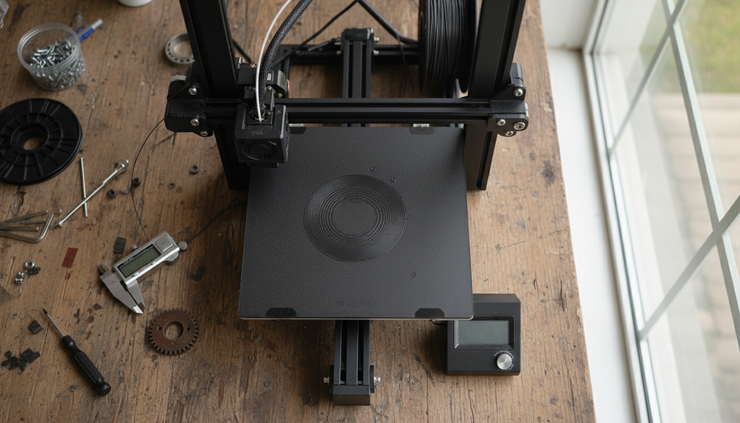
Colour and material choices make reprinting more flexible
A digital model has a major advantage over a single physical object: it can be produced again and again.
That means a scanned keepsake does not have to stay in one form. A hand replica can be printed in white for a clean display, bronze-filled filament for a warm sculptural look, pastel colours for a nursery, or translucent resin for a softer finish. It can also be scaled for different settings, such as a full-size display piece and a smaller version for a gift.
Replacement parts benefit from the same flexibility. A prototype can be printed cheaply to test fit. Once the shape is right, the final version can be printed in a stronger or more heat-resistant material.
This approach helps avoid waste. There is no need to commit to the final material before testing the design. A repairer can print a trial part, check the fit, make changes, then print the working version.
Reprinting also helps when several versions are useful:
A black part to match an appliance
A bright colour for visibility on a tool or machine
A flexible material for a grip or seal
A stronger material for load-bearing use
A resin print for fine detail
A larger display version of a keepsake
For families, this can turn a single scan into multiple gifts. For workshops, it can turn one successful repair into a repeatable file that can be used when the same part fails again.
Accuracy matters most where the part has a job to do
3D scanning is fast, but speed alone is not enough. Accuracy is what makes the process useful.
For decorative keepsakes, small differences may not matter much. The goal is often to capture the feeling of the original object. For mechanical parts, small differences can decide whether the part works or fails.
Accuracy depends on several factors, including:
The scanner’s resolution and calibration
The size and surface of the object
The scanning technique
The quality of the digital clean-up
The production method
The behaviour of the chosen material
A printed part may shrink slightly or behave differently from the original. Plastics flex. Resins can be brittle. Some materials soften with heat. Others absorb moisture. A part that fits perfectly in the file may need adjustment after real-world testing.
This is why good replacement part work often includes test fitting. The first print checks the shape. The second print may refine tolerances. The final version uses the best material for the job.
That process is still often quicker than searching for rare stock, ordering second-hand parts from overseas, or trying to redraw a complex shape from zero.
The real strength of 3D scanning is not only that it copies objects. It captures a starting point that can be repaired, refined, and remade.
Keepsake replicas show the personal side of scanning
Replacement parts solve practical problems. Keepsake replicas show the emotional side of the same technology.
A hand scan can preserve a moment that changes quickly. Children grow. Families change. Pets age. Hand shapes, tiny fingers, gestures, and personal details can be captured and turned into a solid object that lasts.
This is different from a photograph. A photo records appearance from one angle. A 3D replica records form. It lets someone hold the shape, see it from every side, and display it as an object.
Keepsake scanning can be used for:
Baby hands and feet
Parent and child hand poses
Pet paws
Wedding or anniversary pieces
Memorial objects
Family heirlooms
Sculptures and handmade art
The finished piece can be kept simple or customised. A base can be added. The surface can be smoothed or left with fine detail. A name or date can be included. The print can be made in a colour that suits the home or the meaning of the object.
Because the digital file can be stored, the piece can be reprinted later. If one replica is damaged, another can be made. If family members in different parts of Australia want their own copy, the same model can be produced more than once without repeating the scan.

When 3D scanning is the right tool
3D scanning is not needed for every job. If a part is a simple rectangle with two holes, it may be faster to measure it and model it from scratch. If the object still exists as a clean CAD file, scanning may add no benefit.
Scanning shines when the shape is complex, old, handmade, worn, or no longer available. It is also useful when the goal is to capture exact form rather than invent a new one.
A good candidate for scanning usually has one or more of these traits:
It has curved or organic surfaces
It must fit another object closely
It is no longer sold
It has sentimental value
It would take too long to measure manually
It needs to be copied, repaired, or resized
It may need to be produced again later
For mechanical parts, the safest approach is to treat the scan as the start of a design process, not the whole process. Check the purpose of the part. Choose a suitable material. Test the fit. Avoid using home-printed parts for critical safety applications unless the design, material, and production method have been properly assessed.
For keepsakes, the process is more forgiving, but preparation still matters. A steady pose, good scanning access, and clear decisions about size and finish will improve the final result.
A digital copy can become a practical archive
One of the most useful outcomes of 3D scanning is storage. Once an object has been captured and cleaned up, it can be kept as a digital file.
That file can support future repairs, repeat orders, design changes, and family gifts. It also reduces reliance on fragile originals. A rare trim piece, for example, does not need to be handled over and over once it has been scanned. A keepsake model can be preserved even if the printed version is lost or damaged.
For businesses, that digital archive can help maintain equipment, support older products, or build small batches of hard-to-find parts. For families, it can preserve objects that matter. For hobbyists, restorers, and makers, it opens up new ways to repair, adapt, and create.
The most exciting part is how practical it has become. 3D scanning is no longer only for large manufacturers or specialist labs. The tools, software, and production options are far more accessible than they used to be, and the results can be both accurate and deeply personal.
A cracked obsolete part, a cherished handprint, a worn decorative piece, and a one-off workshop fitting all have something in common. Once scanned, they can become digital models that are easier to repair, improve, share, and reproduce.
3D scanning turns physical objects into future-ready files. From there, a missing part can work again, and a small moment can become something solid enough to keep.


Comments